
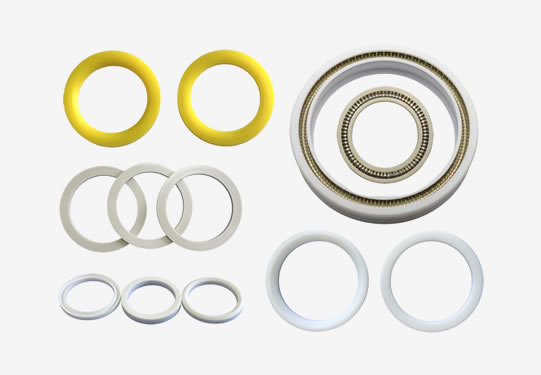




In industries such as chemical engineering, oil refining and pharmaceuticals, high-temperature and strongly corrosive working conditions pose the top challenge for sealing systems. Traditional graphite gaskets are prone to oxidation, stainless steel gaskets lack corrosion resistance, and ordinary rubber gaskets suffer from easy aging. Frequent leakage not only causes material loss but may also trigger safety accidents. Expensive high-end alloy gaskets are not mandatory. Three overlooked specialty niche gaskets, namely Polyimide (PI), Polyetheretherketone (PEEK) and Polyphenylene Sulfide (PPS), are engineered for targeted temperature and corrosion resistance to precisely resolve sealing pain points under extreme working conditions.
I. Polyimide (PI) Gasket: A High-temperature & Corrosion-resistant Solution for Precision Applications
Polyimide gaskets have long been applied in the aerospace sector and remain rarely seen in industrial sealing, yet they deliver outstanding performance in high-temperature, strongly corrosive and precision scenarios. They can operate stably from -200℃ to 300℃, with short-term temperature resistance up to 450℃, and offer nearly comprehensive resistance to corrosive media including strong acids, strong alkalis and organic solvents. More notably, they achieve dimensional accuracy of ±0.01mm, perfectly fitting precision structures such as semiconductor vacuum equipment and high-end chemical reactors. They also feature excellent creep resistance to prevent deformation and leakage under high temperatures. An electronic materials manufacturer previously suffered 1 to 2 leakage incidents per month with graphite gaskets in a 250℃ strong-acid reactor. After switching to polyimide gaskets, the sealing service life was extended to 18 months with no medium contamination, cutting maintenance costs by 60%.
II. Reinforced Polyetheretherketone (PEEK) Gasket: The All-rounder for Moderate-to-high Temperature and Severe Corrosion
Reinforced PEEK gaskets are niche premium options among engineering plastic gaskets. They are not widely adopted due to slightly higher costs than ordinary plastic gaskets, yet they perform comprehensively well in moderate-to-high temperature (200–300℃) and strongly corrosive environments. Made of PEEK resin reinforced with carbon fiber, they withstand temperatures ranging from -40℃ to 300℃ and resist various media including strong acids, strong alkalis and steam. Their corrosion resistance is comparable to PTFE while compressive strength is increased by 50%, with no risk of cold flow deformation under high temperatures. Compared with graphite gaskets, they have superior oxidation resistance and resist aging during long-term service in air at 300℃. Compared with metal gaskets, they allow higher installation tolerance without high-precision flange machining. A pharmaceutical enterprise previously experienced corrosion leakage every 2 months with stainless steel spiral wound gaskets in a 280℃ strong-alkali reactor. After switching to reinforced PEEK gaskets, sealing service life was extended to 10 months and overall operation and maintenance costs were reduced by 45%.
III. Reinforced Polyphenylene Sulfide (PPS) Gasket: The Cost-effective Dark Horse for Moderate Temperature and Severe Corrosion
Reinforced PPS gaskets represent niche engineering plastic gaskets. Often overlooked due to limited promotion, they stand out for cost performance in moderate-temperature (100–260℃) and strongly corrosive applications. Manufactured from PPS resin filled with glass fiber or carbon fiber reinforcement, they work from -40℃ to 260℃ and provide excellent resistance to acids, alkalis, salts and organic solvents, alongside high mechanical strength and strong creep resistance to resist deformation at high temperatures. Compared with PTFE gaskets, their compressive strength rises by 35% and cold flow rarely occurs. Compared with graphite composite gaskets, they have better moisture resistance and resist delamination failure in humid and corrosive environments. A chemical enterprise previously faced monthly damage and leakage with ordinary rubber gaskets in a 220℃ strong-alkali pipeline. After switching to reinforced PPS gaskets, sealing service life was extended to 8 months, and the unit price is only one-third of that of PEEK gaskets, delivering extremely high overall cost performance.