

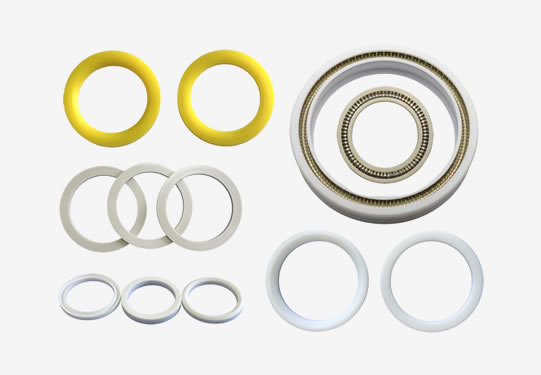




As a core component of sealing systems, the compression rate of an O-ring directly determines sealing performance and service life. Excessively high compression rate tends to cause over-compression damage and permanent deformation, while an overly low value brings risks of leakage. Mastering the scientific calculation method and following the three core steps enables precise control of compression rate within a reasonable range, balancing sealing reliability and component durability.
Step 1: Memorize the core formula to lay the foundation for calculation. Essentially, the O-ring compression rate (W) is the ratio of cross-section compression amount to the original cross-section diameter. The core formula is: W=(d0-d1)/d0×100%. Where d0 stands for the original cross-section diameter of the O-ring (unit: mm), and d1 is the actual working cross-section diameter after compression. For example, for an O-ring with an original cross-section diameter of 5mm and a working cross-section diameter of 4.2mm after compression, its compression rate equals (5-4.2)/5×100% =16%. Note that the formula yields a theoretical value, which shall be modified according to working conditions in practical use to prevent errors from direct application.
Step 2: Precisely control key parameters to avoid basic errors. Incorrect parameter reading is the main cause of mistakes in compression rate calculation, and two points deserve close attention. First, for measuring the original cross-section diameter d0, select the uniform cross-section of the unstressed O-ring, use a caliper with 0.01mm precision, take three evenly distributed measuring points around the circumference and adopt the average value to eliminate the impact of manufacturing tolerances. Second, for determining the working cross-section diameter d1, calculate based on the sealing structure type. In static sealing, d1 equals the groove depth. In dynamic sealing, the fit clearance of moving parts shall be considered: d1 = groove depth − fit clearance compensation (normally 0.02–0.1mm). Meanwhile, refer to material properties of O-rings: Nitrile Butadiene Rubber (NBR) applies to compression rates of 10%–20%, Fluoroelastomer (FKM) 15%–25%, Silicone Rubber (VMQ) 12%–30%, to ensure the calculated result falls within the material-adaptable range.
Step 3: Make revisions based on practical scenarios to avoid over-compression and permanent deformation. Theoretical calculation shall incorporate influencing factors of working conditions. First, temperature correction. Under high temperature (>120℃), O-ring materials soften, so the compression rate shall be reduced by 3%–5% to prevent permanent deformation. Under low temperature (<−20℃), materials harden, so the compression rate shall be increased by 2%–3% to guarantee sealing contact pressure. Second, pressure correction. Under high pressure (>10MPa), O-rings are prone to extrusion into gaps and over-compression damage. The compression rate shall be controlled at the lower limit of the recommended range, and back-up rings shall be used together. Under low pressure (<1MPa), the compression rate can be moderately raised to enhance sealing performance. Third, motion state correction. For reciprocating sealing, the compression rate shall be 3%–8% lower than that of static sealing to reduce friction and wear. Rotary sealing requires an even lower compression rate (8%–15%) to avoid heat generation and aging.
The three-step method of "formula calculation - parameter calibration - working condition correction" realizes precise control over O-ring compression rate. In practical applications, fine-tuning shall also be performed according to specific sealing structures and medium characteristics. Verification and optimization via tests are recommended when necessary. A proper compression rate can not only avoid over-compression damage and permanent deformation, but also extend the service life of O-rings and ensure stable operation of sealing systems.