

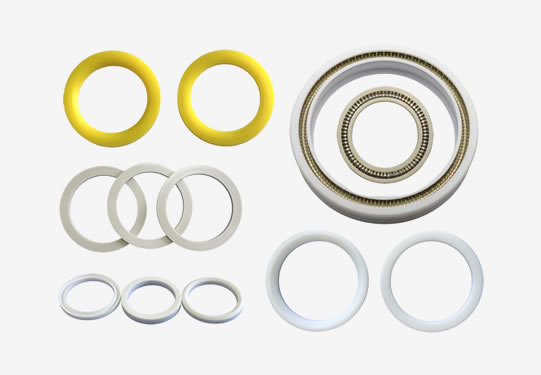




In sealing systems of hydraulic and pneumatic equipment, Y-rings and U-rings are two of the most commonly used reciprocating seals. Many people assume they look similar and serve identical functions, yet they differ markedly in structural design, sealing performance and applicable scenarios. Improper selection will not only cause leakage but also shorten equipment service life. Today we will clarify their core differences at one go and help you avoid selection pitfalls.
Both being sealing rings, how come Y-rings and U-rings differ so greatly?
In terms of structural design, the Y-ring features a Y-shaped cross-section with symmetrical lips and an obvious constricted waist. The U-ring has a U-shaped cross-section with wider lips, an arc-shaped bottom and a stiffer waist. Such structural differences directly lead to different sealing principles. The Y-ring relies on medium pressure to open its lips; the higher the pressure, the better the sealing effect. It belongs to self-energized sealing and maintains good contact even under low pressure. The U-ring achieves sealing through interference fit between lips and sealing surfaces and depends more on pre-compression during installation. Its low-pressure sealing stability is slightly inferior to that of the Y-ring, yet its lips are less prone to overturning under high pressure.
The divergence in sealing performance is especially prominent in working condition adaptation. Thanks to symmetrical lips, the Y-ring delivers balanced bidirectional sealing and low frictional resistance. It suits medium-and-low pressure, high-speed reciprocating applications such as cylinder piston rods and hydraulic cylinder pistons. It effectively cuts energy loss and improves equipment response speed. By contrast, the U-ring boasts wider and thicker lips plus a rigid waist for superior extrusion resistance. It is suitable for high-pressure and heavy-load working conditions such as large hydraulic presses and hydraulic systems of construction machinery. It can retain its sealing profile under high-pressure impact and prevent lips from being extruded out of the groove by medium pressure.
There are also hidden differences in material selection and installation requirements. Y-rings are mostly made of flexible materials like nitrile rubber and fluoroelastomer. During installation, lips must face the medium side, and the clearance of the sealing groove should not be too large, otherwise lip deformation may occur. U-rings are usually made of slightly stiffer materials such as polyurethane. Installation demands higher dimensional accuracy of sealing grooves. Sufficient pre-compression must be guaranteed, and sharp edges that may scratch lips should be avoided. In addition, Y-rings adapt better to environments with drastic temperature fluctuations, while U-rings excel in wear resistance and fit working conditions with minor impurities in the medium.
Do not select seals merely based on appearance. Make decisions according to actual working conditions: choose Y-rings for medium-and-low pressure and high-speed reciprocating motion; choose U-rings for high pressure, heavy load and extrusion resistance requirements. Prioritize Y-rings for bidirectional sealing, and U-rings can be selected for unidirectional sealing depending on pressure. Proper seal selection eliminates leakage risks, reduces equipment maintenance costs and enables longer stable operation of equipment.