

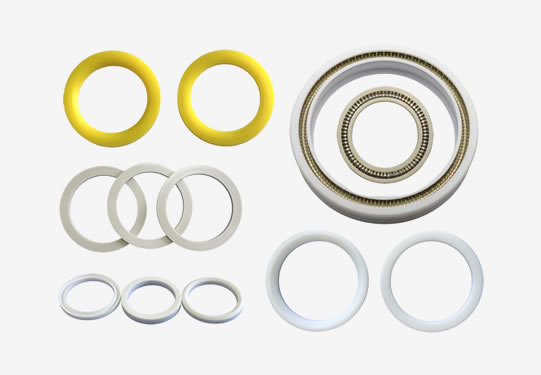




In the production of sterile pharmaceuticals, sealing systems must simultaneously overcome three major technical bottlenecks: chemical resistance, particle control and microbial barrier. Through collaborative innovation in material science and structural design, PTFE seals have become core sealing components for critical equipment such as freeze dryers and bioreactors. Among contamination incidents in the pharmaceutical industry caused by seal failures, 63% stem from insufficient material compatibility or residual surface microorganisms. PTFE seals adopt the following technical system to reduce leakage risk to the 0.001 ppm level and support the safe production of sterile pharmaceuticals.
I. Intrinsic Material Properties Lay the Foundation for Sterility
The carbon‑fluorine bond structure of PTFE seals delivers excellent chemical inertness. They resist erosion by strong acids, strong alkalis and organic media within the pH range of 0–14, avoiding the risk of particle precipitation caused by swelling of traditional rubber materials. After immersion in common solvents for injectables such as DMSO and ethanol, their mass loss rate is less than 0.1%, far lower than the 15% swelling rate of silicone rubber. The ultra-smooth molecular surface (roughness Ra ≤0.05μm) prevents microbial adhesion and growth. Combined with a volume resistivity greater than 1 ×101⁶ Ω·cm, it completely eliminates the risk of electrostatic adsorption of particles. Such inherent material advantages make PTFE seals the preferred sealing solution for sterile filling lines and bioreactors.
II. Surface Functionalization Builds Biological Barriers
With fluorination treatment, the contact angle of PTFE seals rises above 120°, forming a physical hydrophobic barrier to block liquid penetration paths. More innovatively, the nano silver ion doping process (0.5 wt% concentration) creates a molecular-level antibacterial network on the seal surface. Tests verify that it inhibits 99.9% of Gram-positive bacteria activity and breaks the microbial proliferation chain. In freeze-dryer chamber sealing applications, this technology reduces the microbial contamination rate from 0.1% for conventional solutions to 0.0003%.
III. Innovative Structures Adapt to Hygienic Working Conditions
For stringent working conditions of pharmaceutical equipment including high speed, vacuum and frequent sterilization, PTFE seals adopt three innovative designs: • Asymmetric lip structure: Maintains clearance control accuracy at the 0.01 mm level even under -50℃ vacuum environments, preventing leakage induced by low-temperature hardening of rubber seals. • Metal skeleton reinforcement: Permanent compression set ≤15% after 300,000 SIP (Steam-In-Place) cycles, extending service life to three times that of rubber seals. • Modular quick-mount system: Cuts assembly and disassembly time from 4 hours to 30 minutes and reduces contamination risks from exposure in cleanrooms.
IV. Full-lifecycle Sterility Validation System
From raw materials to end service, PTFE seals undergo three layers of validation: • Material biosafety: Compliant with USP Class VI biocompatibility certification to ensure no cytotoxicity or pyrogen release. • Surface cleanability: Bacterial residue on the surface <1 CFU/cm2 after 100 CIP cycles using mixed solution of 3% NaOH +1% HNO₃. • Operational reliability: Friction power consumption stays stable at 15 W in shear emulsifiers with a linear speed of 18 m/s, preventing material degradation caused by overheating.
Built upon chemical inertness, PTFE seals establish a sterility assurance system via surface functionalization, structural optimization and closed-loop validation. As biopharmaceutical manufacturing evolves toward continuous production, their ultra-clean characteristics will continuously drive quality upgrading across the industry.